Monday, February 11, 2013

Bulgarian inventions (What the world does not know)


This is a list of Bulgarian inventions. I am sure that is not all of it but those are the most famous ones: 


  • Ivan (John) Notchev - constructed the engines for the lunar module used during the first landing on the Moon.


  • Roumen Antonov - invented a revolutionary continuously variable transmission.


The Bulgar calendar was a calendar system used by the old Bulgarians to measure the duration of the year. It was acknowledged by UNESCO as the most accurate ancient calendar.

Bulgarian Traditions and Crafts - Martenitsa


Martenitsa is one of the most distinctive pagan rituals in Bulgaria. 
 It embodies many symbols - the welcoming of spring and the sun, the taming of nature by means of magic, propitiation of the unpredictable March. In the Bulgarian folklore, March is the women’s month – often due to the changing weather and reviving nature, which is getting prepared to bear its fruits in summer. People called the month Baba Marta 
(Grandmother March) and considered, that for it to be happy and smiling and to bring sunshine, it needed to be rejoiced. Young and old were taking care for the good mood of Baba Marta. Young people were getting up early before everyone else in order to meet the first day and rejoice with their youth and beauty Baba Marta. Оld women were knitting twisted strands of red and white threads – everyone in the house adorned themselves with martenitsi. These decorations were believed to protect people from diseases and evil forces. Old women were casting charms, while making them, for fertility and health.


Martenitsas have various shapes. Most often they look like simple rings, but they can also be bead-shaped, tassel-shaped, or with male and female figures. These figures are known as Pizho

and Penda. They, like the white and red color of the ornament, symbolize the male and female conception and fertility, of which the fruits of nature will be born. There is a tradition in some areas of Bulgaria to put into the martenitsa blue beads or coins against the evil eye. Martenitsas can be worn from March 1, and they can only be removed when you see the first swallow or stork. After that they should be removed and hung on a flowering tree for fertility. 
Nowadays the tradition is still alive and brings great joy to children. On the first of March young and old people bless Baba Marta and give each other martenitsas. It is believed that only the presented martenitsas bring health.

Martenitsas can also be bought, but many people prefer to make them themselves as a symbol of good wishes to those who will receive them. In order to make a martenitza you need white and red wool yarn.


Martenitsas are decorated in various ways in the different parts of the country. In Melnik, instead of white thread, a blue thread is woven (against the evil eye) and in the Rhodope Mountain people use a few more colors.

Links to tutorials on how to make your own martenitsas (just a small part of what I could find) :
How to make a bracelet martenitsa

Don't forget to be creative. Nowadays you can add any kind of charms or even cartoon character figures or little pins with logos... just be creative. Any martenitsa is a nice one if it has the white and the red color. Give one to any special/close person and show them that you care. It is such a nice but heart warming gesture.

Or you can purchase martenitsas here :
I am not affiliated with any of those websites, products or people. I just tried to pull out and gather the most helpful information I could find.


Wednesday, January 23, 2013

Bulgarian Carpet Making (Kilimarstvo)


Parts of the distinctive charm of the Bulgarian culture are its beautiful carpets and rugs, which decorated the Bulgarian homes in the past. The typical bright and cheerful colors and patterns create a unique and impressive atmosphere and comfort. There are two techniques for ornamentation of decorative fabrics - smooth and tied. The oldest record of textile carpet ornaments in Bulgaria dates back to the late eleventh century. In Bulgaria the carpet making reached its zenith during the Revival Age (18th - 19th century). Some of the famous carpet-making centers of that time were Gabrovo, Kotel, Sliven, Chiprovtsi, Samokov, Panagyurishte, etc. The two main urban centers, however, were the towns of Kotel and Chiprovtsi.The techniques for carpet making bear their names – Kotel and Chiprovtsi techniques.


*The technology for fabric making was known in our country since ancient times - from the 6th - 5th century BC, and according to scientists, carpet weaving began in the 1st century BC.

Bulgarian rugs are doublesided and are weaved on a vertical loom. There are two common ways to form shapes - the Kotel technique is characterized by the formation of open-works (embroidery) on the contour of figures, and the Chiprtsi technique has no open-works.
The oldest Kotel carpets were made of fur and are known under the name “chols”. Later on the craftsmen began using wool, and by the midnineteenth century even cotton was added to the carpet making. The decoration of Kotel carpets is mostly geometric, and later, with the development of the technique, stylized flowers began to appear as well as animals and human figures. In many woven carpets one can see the owner’s name, the year of manufacture and the name of the weaver.
Among the most popular colors are indigo-blue, bright blue, blazing red, burgundy, olive
and black, but there is always only one dominant color. Very typical for the carpet coloring is the fact that it is achieved by natural dyes, for example the green color is derived from walnut leaves. In Kotel carpet was never an ordinary covering fabric. Even in the richest homes the carpets were only used to cover the floor of the room, reserved for family celebrations or for guests. Most typical of the Kotel carpets are the highly stylized stars with hooks - the curly stars. The craftsmen also weaved images of objects from the everyday life into the carpets, such as wine vessels, shepherd’s crooks, etc.

More about the Kotel technique for carpet making can be learned from the exhibition of Old Kotel Carpets and Fabrics at the Galatan School. The Galatan school was built in 1869. The exhibition traces the overall development of the carpet weaving tradition in Kotel - from the rug, through the classical Kotel carpet, to the contemporary models of weaved carpets. The exhibited carpets date back to the 18th - 19th century. The second floor of the building presents an exhibition of unique fabrics in religious and historical themes.

The Chiprovtsi carpets are made of pure wool and cotton. These carpets are known for their small geometric motifs based on triangular forms. The carpets are made with a smooth carpet texture with two faces with edges (one or more) and a main part. For the coloring of the Chiprovtsi carpets are used natural dyes as well. The most typical colors are indigo blue, brown, ocher and green. More about the development of weaving and the textile industry as a whole can be learned in Sliven. In 1836 there was established the first factory in Bulgaria, which was a textile factory. Its founder was the Bulgarian entrepreneur Dobri Zhelyazkov, who studied textile machinery production in Ukraine, then returned to Bulgaria and with the permission of the Ottoman authorities he built the first textile factory in Bulgaria.


Nowadays the only textile museum of its kind, which tells the history of textile production from antiquity to the present day, is located in Sliven. In the museum visitors can see many interesting exhibits, including vertical and horizontal looms, spinning tools, mechanical weaving machines, etc. One of the most valuable exhibits is a jacquard loom, which is part of the revolutionary processes in the technology of fabric production.

Special attention is paid to the work of Dobri Zhelyazkov.
The tradition of carpet-weaving and manufacturing has continued in Bulgaria to the present day. Masters in these two Bulgarian towns - Kotel and Chiprovtsi - continue making Chiprovtsi and Kotel carpets in the traditional technology.

I am providing a link to the website of the textile museum in Sliven, because the website provides virtual tour : 

Bulgarian Yogurt (Kiselo Mlyako)


Bulgarian yogurt (Kiselo Mlyako)

 Bulgarian yogurt is known all over the world for the qualities of
its taste. For the people around the world it is a delicacy and for
Bulgarian people it is part of their daily menu, which is always
present on the table. Bulgarian people use yogurt to make many
dishes. The yogurt is included into the composition of recipes for
soups, salads, desserts, garnishes, etc. Yogurt can be made at home
as long as you follow certain basic rules.
But what makes Bulgaria different from other countries and what causes the fact that only here, this small country on the Balkan Peninsula offers the most delicious yogurt in the world?
The reason lies in a small bacterium known by different names, but it is most often called Lactobacillus bulgaricus. It causes the fermentation of milk and its superb taste. Its discoverer is the remarkable Bulgarian bacteriologist Dr. Stamen Grigorov.

Stamen Grigorov (1878 – 1945)

Stamen Grigorov was born in the village of Studen Izvor in Tran area in 1878. The homeland of Grigorov – the region of Tran, is famous throughout the country for its delicious yogurt. Ever since he was a child, Grigorov was strongly attracted to nature and science, and the teachers at school were impressed by the ease with which he absorbed the material. His curiosity and his ambitions took him to the Male High School in Sofia - the most prestigious school at those times in Bulgaria, and immediately thereafter, to Montpellier, France, where he studied natural sciences. After graduating, Grigorov continued his studies in the sphere of medicine in Geneva, where he met the famous  bacteriologist Professor Masol. The professor was impressed by the young Bulgarian and tolerated him, and he even appointed him as his assistant. This was a great opportunity for Grigorov because it gave him access to the professor’s laboratory, which was one of the best equipped laboratories of its time. And there he made his greatest discovery!
At that time - about the beginning of the twentieth century, the purpose
of Stamen Grigorov was to understand which microorganism caused the
fermentation of milk. At the same time, by the initiative of Pasteur’s Institute in
Paris, whose director was the emigrant bacteriologist from Russia, Ilya Ilyich
Mechnikov, a survey was carried out around the world about the number of
centenarians and their share of the population of each country. Surprisingly,
it appeared that most centenarians lived in Bulgaria. By the way of logic,
Mechnikov concluded that the cause for their longevity lied in the daily
consumption of Bulgarian yogurt. This raised the question - how to make
yogurt in other countries.
Just then Mechnikov received a letter from Geneva, by his colleague Prof.
Massol, from which he learned that the young Bulgarian Assistant of Massol had solved the mystery and had isolated a rod-shaped
bacterium that causes the milk to turn sour and develop a specific taste.
Mechnikov invited the young scientist to Paris, where he offered him to
present his discovery to the most influential scientific community. Grigorov
delivered his report and induced the applause of the scientists. Soon his
name appeared in numerous scientific journals and was added to the
name of the bacterium - “Lactobacillus delbureckii subsp. bulgaricus
Grigoroff 1905 “.
Later, after completing his doctorate, Grigorov returned to Bulgaria
and diverted a number of proposals. One of them was to take over the
leadership of the Pasteur Institute in Sao Paulo, Brazil. The young doctor
returned to his native county and became a physician and head of the
hospital in the town of Tran. Later, he worked on a number of studies on
the treatment of tuberculosis and lung diseases. He died in Bulgaria
in 1945.
Nowadays, owing to Dr. Stamen Grigorov, the centuries-old secret of
yogurt is solved. Its undeniable taste and dietetic qualities are the reason
it is known all over the world and is one of the symbols of Bulgaria.
Nowadays in the home village of Stamen Grigorov there is
a museum dedicated to yogurt. The museum is situated in a
recently restored old house. The first floor exhibits an interesting
ethnographic collection of female costumes from the area of
Tran, as well as various containers and equipment for dairy
products production and storage. There is a “lump” for butter
churning and other ceramic cookware for yogurt making. The exhibition on the second floor is dedicated to industrial production of yogurt and to the discoverer of the sour milk bacteria.

Recipe


In order to make yogurt at home, you will need milk and
some yogurt for ferment (1 tablespoon yogurt will be
enough for a liter of milk). Boil the milk in advance and let it
cool to a temperature of about 42-45° C. If you don’t have a
thermometer, you can dip your little finger in the milk. It is
suitable for souring if it is not hot and has a pleasant warm
temperature.


1.
Pour the boiled milk in a pot,
leaving about 50 grams aside.
2.
Prepare the ferment in another
small bowl. Mix the yogurt
with the rest of the milk and
stir.
3.
Add the ferment to the warm
milk and stir.
4.
Cover the container with a cloth to
keep the heat and leave for 3-4 hours,
check it from time to time.
5.
Remove the towel and leave
the milk to cool after you
make sure that the milk has
fermented.
Milk should not be allowed to ferment longer, as it will become
too sour and won’t have a pleasant taste. The ready yogurt can
be consumed directly or can be included in other meals - tarator
(cucumber soup), salad, buttermilk, desserts, etc. The milk has best
taste qualities when it is cold.

I also found this amazing website which includes a lot of recipes with bulgarian yogurt and decided to share it with you : 

Enjoy ! 

Sunday, January 20, 2013

The Bulgarian Alphabet


Here is the Bulgarian Phonetic:


Here is how we write the letters (handwriting) : 


Common expressions you might need to know: 


A little bit of history behind the alphabet :

The Cyrillic script or azbuka is an alphabetic writing system. It is based on the Early Cyrillic, which was developed in the First Bulgarian Empire during the 10th century AD at the Preslav Literary School. It is the basis of alphabets used in various languages, past and present, in parts of the Balkans and Northern Eurasia, especially those of Slavic origin, and non-Slavic languages influenced by Russian. As of 2011 around 252 million people inEurope and Asia use it as the official alphabet for their national languages. About half of them are in Russia. Cyrillic is one of the most used writing systems in the world.
Cyrillic is derived from the Greek uncial script, augmented by ligatures and consonants from the older Glagolitic alphabet and Old Church Slavonic for sounds not found in Greek. It is named in honor of the two Byzantine Greekbrothers, Saints Cyril and Methodius, who created the Glagolitic alphabet earlier on. Modern scholars believe that Cyrillic was developed and formalized by early disciples of Cyril and Methodius.
With the accession of Bulgaria to the European Union on 1 January 2007, Cyrillic became the third official script of the European Union, following the Latin and Greek scripts.


Birds In Bulgaria


 Bulgaria occupies a very favorable location - the migratory paths of many birds pass through the country. Bulgaria is one of the countries in Europe with the greatest biodiversity, especially regarding birds, and it is one of the countries with the highest bird concentration. So far in Bulgaria are registered and recorded 397 bird species, 59 of which were seen for the first time in the last 50 years. Two of the main migration bird routes - Via Pontica (Black Sea coast) and Via Aristotelis (along the Struma River Valley) pass through our country. There are 90 important ornithological areas in Bulgaria. 57 of them are wetlands. The easily accessible ornithologically important areas are frequently visited and are included in each bird monitoring program. There are about 40 such places in the country. Some the most important places are the lake Srebarna, the Danube wetlands, the Burgas lakes - Vaya, Atanasovsko lake, the area Poda, the Pomorie lake, Kamchia and Ropotamo reserves, Alepu swamp, the Black Sea cape Kaliakra, the Shabla and Durankulak lakes, the area near the town of Madzharovo in the eastern Rhodope mountain and many others. Most of these places have visitor centers and special facilities for bird observation. In Bulgaria, Natura 2000 (general European network of protected territories) includes 114 protected areas for wild birds preservation, covering 20.3% of the territory of the country.

Biosphere Reserve “Srebarna”


The lake Srebarna is located near the Danube River, 16 kilometers west of Silistra. Due to its high biodiversity, the lake was declared a reserve.In Srebarna Reserve, which is under the aegis of UNESCO, lives a colony of over 200 Dalmatian pelicans (the largest colony in Europe). Srebarna is one of the most important nesting places in the country for the little bittern, the black crowned night heron, the squacco heron, the glossy ibis and the Eurasian spoonbills. Some of the birds, which spend the winter at this reserve, are the globally endangered pygmy cormorants and the red-breasted goose. During the winter season, there is a significant concentration of greater white-fronted gooses, grey gooses and fieldfares at the reserve.


Natural Park “Persina”

The natural park “Persina” is located at the northern border of Republic of Bulgaria, along the river valley of the Danube river. It covers all Bulgarian Danube islands in this part of the Danube river. One of the greatest wealths of the park is birds – more than 200 species have been described. The Belene island complex was determined as one of the five most important habitats in the region for the large cormorant (Phalacrokorax carbo), small cormorant (Palacrocorax pygumeus), nocturnal heron (Nycticorax nycticorax), sandwich heron (Ardeola ralloides), etc. Five nests of sea eagle (Haliaetus albicill) have been registered on the territory of the park, as well as two couples of these bird species. The park offers specified eco routes with places for relaxation, as well as shelters for bird watching.


Atanasovsko Lake


Atanasovsko lake is located northeast of Bourgas. It is home to over 300 registered bird species.  14 of them are globally endangered: the Dalmatian pelican (Pelecanus crispus), the Pygmy Cormorant (Phalacrocorax pygmeus), the Red-breasted goose (Branta ruficollis), the lesser white-fronted goose (Ansererythropus), Slender-billed Curlew (Numenius tenuirostris), the Corncrake (Crex crex), the Ferruginous Duck (Aythyanyroca). The migration route Via Pontica passes over the lake. Atanasovsko lake does not freeze in winter, which makes it a preferred wintering place for waterfowl birds. In summer the lake is populated by winged Stilts (Himantopus himantopus), Pied avocets (Recurvirostraavosetta) and other birds.


Poda Area

The protected area Poda is located four kilometers south of Burgas at the left side of the main road from Burgas to Istanbul. It is managed by the Bulgarian Society for Protection of Birds. It is one of the richest ornithological sites in Europe and is home to 265 bird species, such as the only mixed colony of white spoonbill (Platalea leucorodia) , glossy ibis (Plegadis falcinellus), night, red, gray, Squacco and Little Egret (Ardea) at the Black Sea coast. 46 of the species are nesting, and the most attractive among them are the river terns (Sterna hirundo), large cormorants (Phalacrocorax carbo), various species of diving ducks (Aythya) and ducks (Anatidae), Marsh Harrier (Circus aeruginosus) and others.

Burgas Lake (Vaya)

The Burgas lake is located in the heart of Burgas, between two of its residential sections -Upper and Lower Ezerovo. It is also known as Lake Vaya. It is the largest natural lake in the country. During the various seasons, here visitors can see about 260 bird species. Many of them are rare in the country and Europe, and nine species are globally endangered. There are few places in Bulgaria where one can observe a gathering of nesting colonies of Night Herons (Nycticorax nycticorax), Little Egrets (Egretta garzetta) and Squacco herons (Ardeolaralloides). In winter here gather small cormorants (Phalacrocorax pygmeus), Dalmatian pelicans (Pelecanus crispus), red-breasted geeses (Branta ruficollis), stiff-tailed ducks (Oxyura), pochards (Aythya ferina) and hooded ducks (Aythya fuligula).


Pomorie Lake

The Pomorie lake is located at a distance of 25 kilometers from Burgas and 2 kilometers north of Pomorie. The bird migration route Via Pontica passes above it. This is the reason for its wide variety of birds - a total of 269 species (nesting, wintering, migratory). 57 bird species nest in the region, such as Sandwich Tern (Sterna sandvicensis), Pied avocet (Recurvirostra avosetta), Black winged stilt (Himantopus himantopus), kentish plover (Charadrius alexandrinus), common tern (Sterna hirrundo), Little Tern (Sterna albifrons) and others. The only Museum of Salt in Bulgaria is located at the veryshore of Pomorie lake.

Alepu Swamp

Alepu swamp is located about 7 kilometers south of Sozopol. The area is habitat for many rare animal and plant species. The swamp is habitat and wintering place for the pygmy cormorant (Phalacrocorax pygmeus), various species of herons, ducks and swans. The area is one of the few nesting sites of the sea eagle (Haliaeetus albicilla) at the Black Sea coast. 


Ropotamo Reserve


Ropotamo Reserve is located about 50 kilometers south of Burgas, at both sides of the Ropotamo river. The area is home to 260 bird species, including white stork (C. Ciconia), sea eagle (Haliaeetus albicilla) and Semicollared Flycatcher (Ficedula semitorquata), various types of herons, ducks, pygmy cormorants (Ph. Pygmeus).


Kamchia


The Kamchia Reserve covers the lower valley of Kamchia river, 25 kilometers south of Varna. 258 bird species are registered in the area, which is about 66% of the species diversity in Bulgaria. Kamchia reserve is a nesting area for several rare for Bulgaria and Europe bird species such as the black stork (Ciconia nigra), the small spotted eagle (Aquila pomarina), the Eurasian hobby (Falco subbuteo), and others. Here passes the migration route Via Pontica.

Cape Kaliakra

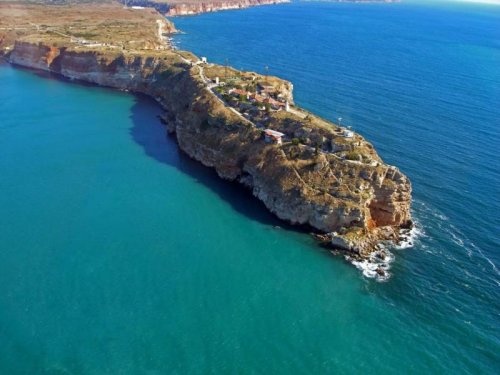
Cape Kaliakra is situated 80 kilometers north of Varna, 12 kilometers east of Kavarna and 4 kilometers from village of Balgarevo. Every autumn from August to October, considerable number of migratory birds cross the territory over cape Kaliakra - more than 29,000 storks, pelicans and cranes, and over 3,000 raptors, including the globally endangered species Pallid Harrier (Circusmacrourus), Saker Falcon (Falco cherrug) and Imperial Eagle(Aquila heliaca).


Shabla Lake


The protected area Shabla lake is located in northeastern Bulgaria, about 5 kilometers
from Shabla and 18 kilometers from the border between Bulgaria and Romania. 247 species of birds have been identified on the territory of the locality. 137 bird species are of European importance. Shabla lake is a nesting area for endangered species such as the corncrake (Crex crex) and the ferruginous duck (Aythya nyroca). During autumn and winter visitors can see the White headed Duck (Oxyura leucocephala), Dalmatian Pelican (Pelecanus crispus), Pygmy Cormorant (Phalacrocorax pygmeus). 80-90% of the world population of the Red-breasted goose (Branta ruficollis) winters in the area of Shabla lake.


Durankulak Lake


Durankulak Lake is located 15 kilometers north of Shabla. Here passes the migratory route Via Pontica. 256 bird species have been registered in the area, 92 of them are nesting. The lake is a nesting place for the Small bittern (Ixobrychus minutus), Lesser grey Shrike (Lanius minor), Ferruginous Duck (Aythyanyroca), sea plover (Charadrius alexandrinus) and others. The lake is a wintering place for the populations of three species of waterfowl birds - large whitefronted goose, red breasted goose, green-headed goose.


Madzharovo

In the Eastern Rhodope, 10 kilometers northeast of the town of Madzharovo, lies the village of Borislavtsi, and the area between the two towns is one of the most popular destinations for ornithological tourism in the country. 174 bird species are registered, 78 of which are of European conservation concern. Among the interesting species are Spanish Wheatear (Oenanthe hispanica), the large olive warbler (Hippolais olivetorum), the Subalpine Warbler (Sylvia cantillans), the small Black-headed Warbler (Sylvia melanocephala), the rock nuthatch (Sitta neumayer) and Black-headed Bunting (Emberiza melanocephala), lesser kestrel (Falco naumanni), Griffon vulture (Gyps fulvus), black stork (Ciconia nigra).